


Cyberattacks can expose customer data, interrupt operations, and damage business trust. Many organizations still manage security through separate tools and disconnected processes. Cybersecurity frameworks provide a structured way to bring these efforts together and create a clear security direction.
For U.S. businesses, security decisions can involve customers, contracts, industry rules, and federal requirements. A strong cybersecurity framework helps connect these needs with practical risk management. It gives teams a repeatable approach for protecting systems, responding to incidents, and improving their security posture.
What Are Cybersecurity Frameworks?

Cybersecurity frameworks are structured guidance models that help organizations manage digital security risks. They organize important activities such as identifying assets, protecting systems, detecting threats, responding to incidents, and recovering from disruptions. They can also help define responsibilities across technical and business teams.
Think of an information security framework as a roadmap for protecting digital assets. It does not require every organization to use identical tools. Instead, it provides a structure for selecting appropriate security controls, measuring progress, and addressing weaknesses based on actual business risks.
How a Cybersecurity Framework Works
A cyber security framework connects security goals with practical activities. Teams can use it to perform risk assessment, manage access control, strengthen network security, and improve incident planning. Frameworks also create a common language for discussing security between executives and technical teams.
Common Cybersecurity Frameworks Explained
There are many security frameworks designed for different purposes. Some focus on broad risk management while others provide detailed controls or address specific industries. Understanding these cybersecurity standards helps organizations select an approach that matches their size, risks, data, and business requirements.
| Framework | Main Focus | Common Use |
| NIST CSF | Cybersecurity risk management | Organizations of different sizes |
| NIST SP 800-53 | Security and privacy controls | Federal systems |
| ISO 27001 | Information security management | Enterprise security programs |
| CIS Controls | Prioritized safeguards | Practical security improvement |
| COBIT | IT governance | Business and technology alignment |
| MITRE ATT&CK | Attacker behavior | Threat detection |
| PCI DSS | Payment card protection | Payment environments |
| SOC 2 | Trust and controls | Service organizations |
| HIPAA | Health information protection | Healthcare |
| CMMC 2.0 | Defense information protection | DoD supply chain |
| GLBA | Financial information protection | Financial institutions |
| FISMA | Federal information security | Government environments |
| FFIEC | Financial cybersecurity guidance | Financial institutions |
NIST Cybersecurity Framework and NIST CSF
The NIST Cybersecurity Framework provides flexible guidance for managing cybersecurity risk. The NIST CSF 2.0 organizes cybersecurity activities through Govern, Identify, Protect, Detect, Respond, and Recover. These functions help organizations connect security work with broader organizational goals.
NIST SP 800-53 and ISO 27001
NIST SP 800-53 provides detailed security and privacy controls for information systems. It is especially relevant to federal environments and organizations with demanding security requirements. ISO 27001 focuses on an information security management system that uses risk-based planning and continual improvement.
CIS Controls and COBIT Framework
The CIS Critical Security Controls provide prioritized safeguards that organizations can use to strengthen everyday defenses. The CIS Controls are especially useful when teams need practical security actions that address common attack paths without creating unnecessary complexity.
The COBIT framework has a stronger governance focus. It helps organizations connect technology decisions with business objectives, accountability, performance, and risk. This makes COBIT useful when leaders need a clearer connection between technology investments and business risk.
MITRE ATT&CK, CMMC 2.0, and Industry Standards
MITRE ATT&CK maps real-world attacker tactics and techniques. Security teams can use it to improve threat detection, threat hunting, testing, and defensive coverage. CMMC 2.0 addresses cybersecurity requirements within the U.S. defense industrial base for organizations handling applicable federal information.
Other important cybersecurity framework examples include PCI DSS, SOC 2, and HIPAA security requirements. Financial and government environments may also encounter GLBA, FISMA, and FFIEC guidance. Each serves a different purpose and should be evaluated according to the organization’s obligations.
Benefits of Cybersecurity Frameworks
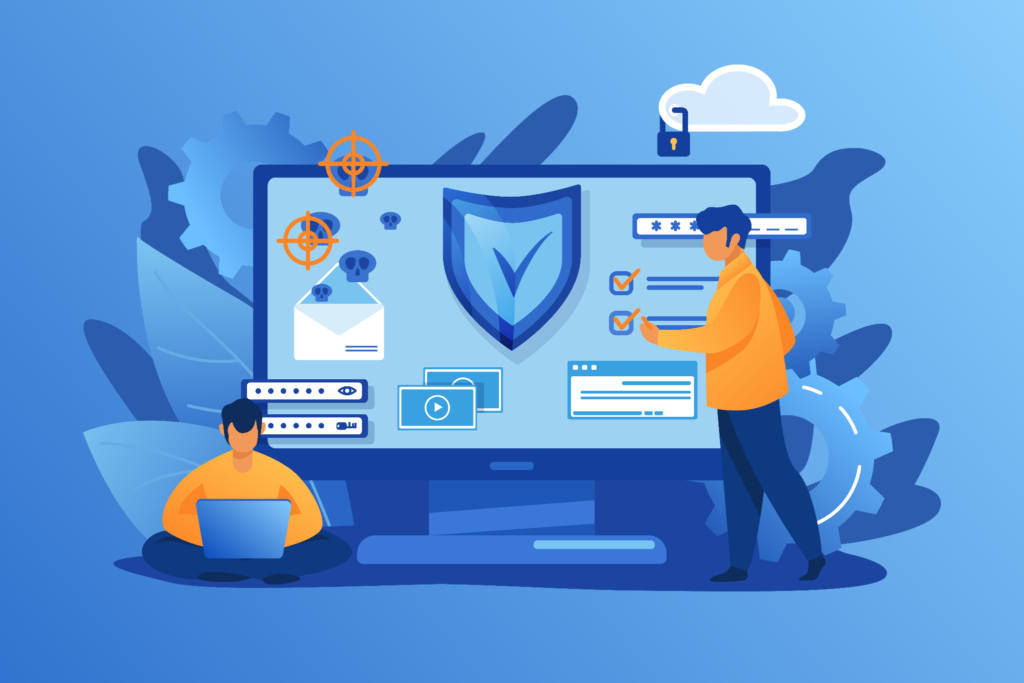
The biggest benefit of cybersecurity frameworks is structure. Security teams often face many competing priorities. A framework helps connect those priorities to actual risks and business needs. This makes it easier to focus limited staff, time, and money on meaningful security controls.
Frameworks can also strengthen security governance and accountability. Teams can document security policies, identify control gaps, and measure progress over time. They can also support vulnerability management, endpoint security, incident response, and data protection through consistent processes.
How Organizations Use Security Frameworks
Organizations use security frameworks differently based on their size and industry. A small company might focus on practical safeguards. A SaaS provider may combine NIST guidance with SOC 2 expectations. A government contractor may need detailed controls that support federal contracts and specific compliance obligations.
Frameworks can become part of daily security operations. Teams can use them to review identity management, supplier risks, access permissions, backups, logging, and incident procedures. This creates a repeatable security program instead of relying on individual employees to remember every security task.
A Practical Business Example
Imagine a U.S. software company that stores customer information in cloud platforms. The company can begin by identifying its systems and sensitive data. It can then review user permissions, strengthen multi-factor authentication, improve logging, and test its backup process.
The organization can compare these practices with its selected framework. A gap analysis can reveal missing controls and weak processes. High-risk gaps can receive priority while lower-risk improvements follow later. This creates measurable security maturity without requiring every improvement at once.
Cybersecurity Frameworks vs. Compliance
A cybersecurity framework and a compliance requirement are not always the same thing. Frameworks generally provide structured guidance for managing security risks. Laws, regulations, contracts, and industry requirements can create specific compliance requirements that certain organizations must satisfy.
For example, NIST CSF can help organize a broader security strategy. Meanwhile, HIPAA, PCI DSS, GLBA, CMMC, and federal requirements may impose obligations based on an organization’s activities. Strong cybersecurity compliance therefore requires understanding both security practices and applicable regulatory requirements.
| Cybersecurity Framework | Compliance Requirement |
| Provides structured security guidance | Creates specific obligations |
| Often flexible and risk-based | Depends on applicable rules |
| Supports broader security goals | Focuses on defined requirements |
| Can be adapted to business needs | May require documented evidence |
| Example: NIST CSF | Example: HIPAA or PCI DSS |
Organizations can use both approaches together. A framework can provide the overall security structure while compliance requirements identify mandatory safeguards. This can reduce duplicated work and create a more consistent approach to information security, data privacy, and risk management.
How to Choose the Right Cybersecurity Framework
Choosing the right framework starts with understanding your organization. Consider the type of data you handle, your technology environment, major cyber threats, and potential business impact. Then examine customer expectations, industry standards, contracts, and applicable regulations.
Your available resources also matter. A small organization may need simple security best practices that its existing team can manage. A federal contractor may need detailed controls and evidence. A larger enterprise may combine several cybersecurity standards and frameworks to address different risks and business requirements.
Questions to Ask Before Choosing a Framework
Before choosing a framework, examine your most valuable assets and highest-risk systems, review existing security controls, policies, weaknesses, regulations, and required security evidence, while ensuring the framework supports long-term security improvement and can adapt to emerging threats without unnecessary complexity.
How to Implement a Cybersecurity Framework

Implementation should begin with a clear picture of the current environment. Identify systems, users, assets, data, suppliers, and major risks. Then conduct a risk assessment and gap analysis against the selected framework. This creates a baseline for deciding which improvements deserve attention first.
Next, assign responsibilities and establish measurable goals. Strengthen important areas such as access control, encryption, patch management, backups, endpoint security, and incident response. Document processes and train employees. Strong implementation depends on people, processes, and technology working together.
The process should not stop after the initial rollout. Continuous monitoring, testing, reviews, and incident exercises help organizations respond to changing risks. Regular measurement also shows whether controls remain effective. Over time, the framework becomes part of normal operations and supports ongoing security maturity.
Conclusion
Effective cybersecurity frameworks give organizations a practical structure for managing digital risk. They connect people, technology, policies, controls, and business goals. The right approach depends on your industry, organization size, data, customers, contracts, and regulatory environment.
Adopting a framework is only the starting point. Long-term protection requires ongoing risk management, security monitoring, testing, and improvement. When framework guidance becomes part of daily operations, organizations can build stronger defenses and respond more effectively to changing cyber risks.
FAQs
1. What are cybersecurity frameworks?
Cybersecurity frameworks provide guidelines for managing and reducing digital security risks. They help businesses protect systems, data, and networks.
2. Why are cybersecurity frameworks important?
They give organizations a structured approach to identify risks and improve security. They also help teams maintain consistent security practices.
3. What is the NIST Cybersecurity Framework?
NIST CSF is a flexible framework for managing cybersecurity risks. It covers Govern, Identify, Protect, Detect, Respond, and Recover.
4. Which cybersecurity framework should a business use?
The right framework depends on the business’s industry, risks, data, and compliance needs. Many organizations use NIST, ISO 27001, or CIS Controls.
5. Are cybersecurity frameworks required by law?
Not all frameworks are mandatory. However, certain industries may have legal, regulatory, or contractual security requirements.

Welcome to The Tech Millon! I’m Ethan Clark, an AI-Powered SEO and Content Writer with 4 years of experience. I help websites rank higher, grow traffic, and look amazing. My goal is to make SEO and web design simple and effective for everyone. Let’s achieve more together!